- Referrals – You need to know people with money;
- Traction – Must show momentum and revenue progress (smell like money)
- Cash flow break even – Must show the business will cash flow
- Exit potential – You’ve got to matter in the strategic evolution of the market
- Tenacity and perseverance – don’t accept no
- Time – It takes longer than you think to raise money (plan on 6 months)
Weird economic story about crashing my car
I bought my 2007 Prius for approx $28,500 in July of 2007. About 3 weeks ago, I skid on some black ice and ended up taking the Prius 4 wheel driving -- unintentionally -- of course. In case you were wondering, Prius don't do well when driving off road. I walked away unhurt -- thank goodness!! Very lucky.
I filed with my insurance company. They have determined that the car is a total loss (damage throughout the underside of the car and the axels) and are compensating me with $27,000. I believe they determined the value of the car by looking at the blue book value of the car. Two observations:
- The blue book was written in advance of the current market "recession" and massive decrease in car and home prices. I really wonder if I could have sold my car for the blue book value ! ;-)
- Makes me wonder about what other weird asset valuations are going on as a result of the timing of the publication of "blue books". Are home appraisers giving accurate reflections of housing values during all these re-fi's? What do you think?
There's nothing like a clean bill of health
My mom called me this morning to let me know that her heart was doing better. In the scheme of all the bad news in the world (primarily financial) -- this was a welcome bit of good news. Theres' no question that being healthy is a great gift. Knock on wood.
Say goodbye to these newspapers
As a guy interested in local search, this article about the top 10 newspapers to fail is interesting.
Goldman Sachs Internet Conference
I'm at the conference this week. If you're here and want to get together please emai me.
The conference was supposed to be in Las Vegas. Last week, Pres. Obama stated that firms who took TARP money shouldn't use tax payer money for boondoggles in Las Vegas so Goldman changed the locale for the conference to the Marriott hotel in San Francisco. Not nearly as fun -- but at least we won't read about the conference on the front page of the WSJ or NYT!
The benefits of skiing at a resort in bankruptcy
I spent last week on vacation with the family at Tamarack Resort, Idaho. We had a fabulous week. Because the resort is new, a bit hard to get to, and in financial trouble, the mountain was empty. In fact, about half of the runs over the week, I didn't see another person while skiing down the mountain. It was both awesome and a bit eery. I've likened the experience to swimming in an olympic pool alone.
Out of office for the week
I won't be posting this week.
Brad Feld is coming to town
It's not quite Christmas, but he's coming to Seattle to hang out and have a beer. Come join us here.
Founder's Co-op announces a new investment
Nationalizing the banks
Read this article to find out why I'm in favor of nationalizing the banks.
Is it better to sell additional revenue or pain relief in this market?
That's the question Lookstat is actively considering right now. The company has 2 products that it delivers to photographers. The first is a back office service that allows photographers to upload, tag and touch up photos to microstock photography sites. The second product is an analytics offering that enables photographers to track their sales by photo at the microstock photography sites. At a board meeting lunch last week, we hypothesized that in this bear market that photographers would be more interested in increasing their sales 20+% than in paying Lookstat for back office services. The thought was that in this market photographers would be more willing to do their own uploading, tagging and touching up of photos. It turns out that hypothesis seems to be wrong. Initital feedback on the two products is that both are quite promising but that photographers really like and need the pain relief that the back office services offer. Go figure. So much for smart board member insight over lunch. Lesson learned -- ask your customers, they often (though not always) customers know best.
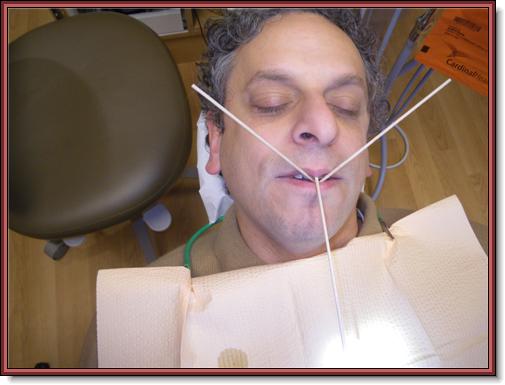
A wonderful happy day at the dentist....
Advice for entrepreneurs seeking investment: Pull your company's pants down
In the go-go technology markets of 1994-2000 and 2003-2008, raising money was relatively easy. The game had many players, and in many ways, it was an entrepreneurs market. During those markets, many entrepreneurs viewed getting financing as a subtle art of playing one investor or venture capitalist off of another (Note: I didn't view it this crassly but was aware of the strategy). During these periods of time, It was common entrepreneurial knowledge not to tell investors your true cash position nor to tell investors exactly what investors you were pitching.
Now, it's 2009. In case you haven't noticed, the world is different. The fund raising climate is very different and it's now much more of an investor's market.
I had a meeting with a couple entrepreneurs recently. They have a company with 6 employees, that generates about 20K per month in revenue and are trying to raise 500K at $3,000,000 pre-money. I thought they were dreaming and told them so. In the interest of giving them productive feedback, I told them they shouldn't waste their time and investors time trying to optimize on a financing deal. 500K at 3MM is a non-starter for a 20K revenue per month company. The entrepeneurs have a good idea and need some cash. My suggestion to the entrepreneurs was to put their cards on the table in an attempt to get the cash they need to survive.
It's a bit counter-intuitive to let investors know your true business position and to show your weaknesses and limitations. However, if an investor is interested in parting with their cash -- and there are some investors out there still looking to invest (ourselves included) -- then, I'd suggest putting your cards on the table (i.e. tell the investor how much you need, what valuation you'd need, and how much cash is in the bank -- in other words, pull your company's pants down) moves the financing conversation along the quickest to see if there might be a deal -- and finding out if there might be a deal is more important than optimizing on valuation. Period.. Make sense?
Managing in a tight underwear world
I was speaking with one of my portfolio companies (LookStat of Orange Line Media)today and told the CEO exactly the words above -- you're managing in a tight underwear world. Everyone at lunch laughed and then suggested it be the title of my next blog post. What I meant by the comment is the following:
- The CEO has just enough time and money to get the company to profitability.
- The investing environment sucks -- few to no deals are getting done.
- There's not a lot of room for mistakes, delays, or misses.
That's the state of the world. Make it happen.
On a side note, I have no doubt that we'll all look back at this post in a year and laugh more because I'm super bullish on Lookstat's prospects and think Rahul and Casey are doing a bang up job.....even with tight underwear.
The complaining about the 500K cap is ridiculous
There are 2 main arguments I'm hearing from people about the 500K cap that Obama and team have imposed on Wall Street as part of receiving TARP funds:
- Retain the best: As a financial company shareholder, I want/need the best and the brightest in their positions and thus, need to be able to retain employees who make more than 500K per year.
- Socialism: Government caps on salary amount to a cap on success will engender socialism and a welfare society
I'm sorry but both of these arguments, in my humble opinion, are complete bull shit. The financial industry employees should have senior executive bonuses for the past 3 years clawed back simply for making the idiotic decision to pay bonuses equivalent to 2004 this year -- let alone for their contributions for getting us into this mess!
The illusion of security
As layoffs accumulate from big profitable companies across the board: Boeing, Microsoft, DHL, etc. I've met with a number of people who have worked at these companies for 10+ years and now find themselves out of work for the first time and don't know what to do about it. These big companies historically offer people the illusion of security -- they're supposed to be safer than small companies. And while big companies and their big piles of cash do offer security, I'm beginning to wonder if it's not safer to be in a small profitable company than a big one. At a small profitable company, your contributions are likely more critical and impactful than in a fortune 500 company.
Be generous, but not stupid
This was the advice I gave an entrepreneur about leaving his company after 3 years of hard work without financial success. The entrepreneur was in the midst of dealing with the emotionally challenging time of "breaking up" with his partners and was asking me for advice. I told the entrepreneur that separating from a company that one founded is hard to do and it is precisely at that time that you want to be more generous than not with your co-founders without violating the -- don't be stupid rule.
Investor advice: Put your helmet on
Last week I used stepping in dog shit as a metaphor for the current climate -- you can read that post here.
Today, I have a different metaphorical story. Just before Christmas, it snowed 6 to 8 inches in Seattle. That's a lot of snow for a city that can't handle 1 inch of snow. With the snow, the roads got shut down, and the kids went sledding on all the hills. My daughter was having a great time bombing down the hills until 5PM -- dusk was setting in, visibility becoming a challenge and she sledded right into a fire hydrant. She knocked herself out. Fortunately, we didn't have to go to Children's hospital and she was fine. Why in god's name did we not require her to wear a helmet?! In the excitement and newness of the snow, we just plain forgot -- and lost site of the risks. We're the kind of parents that always make her wear a helmet when she's biking and now she's sledding with less control than she does when she's on her bike? Oops. It only takes a second.
Which brings me to today -- It feels like investors got hit in the head and knocked out in Q4 of 2008 and now are only reminded of the risks of investing. Everyone is taking every protection possible and many are simply avoiding the activity all together. My suggestion is make sure you have your helmet on, it's a bit dangerous, but the sledding is still fun.
Newt Gingrich knew what was going on
The below is from the hugginton post....I think it's interesting comment.
After making a list of political analysts that thought Barack was a flash in the pan and that the political race was between Hilary and everyone else....The author points out that Newt Gingrich knew what was going on.
So, whose compass was registering properly two years ago? How about former House Speaker Newt Gingrich?
"Well, Abraham Lincoln served two years in the U.S. House, and seemed to do all right." Newt Gingrich, "Meet the Press," NBC, Dec. 17, 2006, when asked about Obama's lack of experience.
"I do think every Republican ought to look at the reception Barack Obama got a week ago [during his very well-received first visit to New Hampshire]... The interest in him tells you something about Americans more than it tells you about him." Newt Gingrich, Dec. 15, 2006.
Welcome Barack Obama
How appropriate is it that Obama's inauguration is the day after MLK day?